
CINCINNATI PROPERTY TAX GUIDE
Cincinnati Property Taxes: Rates, Bills, and What to Know
Looking for Cincinnati property tax rates or trying to understand your home's tax bill? This guide helps homeowners and buyers understand how local property taxes work, why amounts vary, and how to find tax information for a specific property.
Why Property Taxes Matter in Cincinnati
Property taxes are part of the ongoing cost of owning a home. Whether you already own a home or are comparing properties to buy, understanding the annual tax bill can help you plan your housing budget.
Two homes with similar values can have different property tax bills. The county, city or township, school district, and local levies can all affect the amount owed, so it helps to check the taxes for the specific property.
How Much Are Property Taxes Per Year in Cincinnati?
There is no single annual property tax amount that applies to every Cincinnati-area home. Your bill depends on the property's taxable value and the taxes that apply in its location, including county, school district, city or township, and local levies.
Two homes with similar values—even in the same county—can have different yearly tax bills.
To find the current amount for a specific home, check its county property records or tax bill. Look for the full annual amount when planning your budget.
Find Your Property Taxes by County
Use the links below for the county where the property is located. You can search by owner's name, property address, or parcel number. The available search options and labels may vary by county.
Hamilton County
Butler County
Clermont County
Warren County
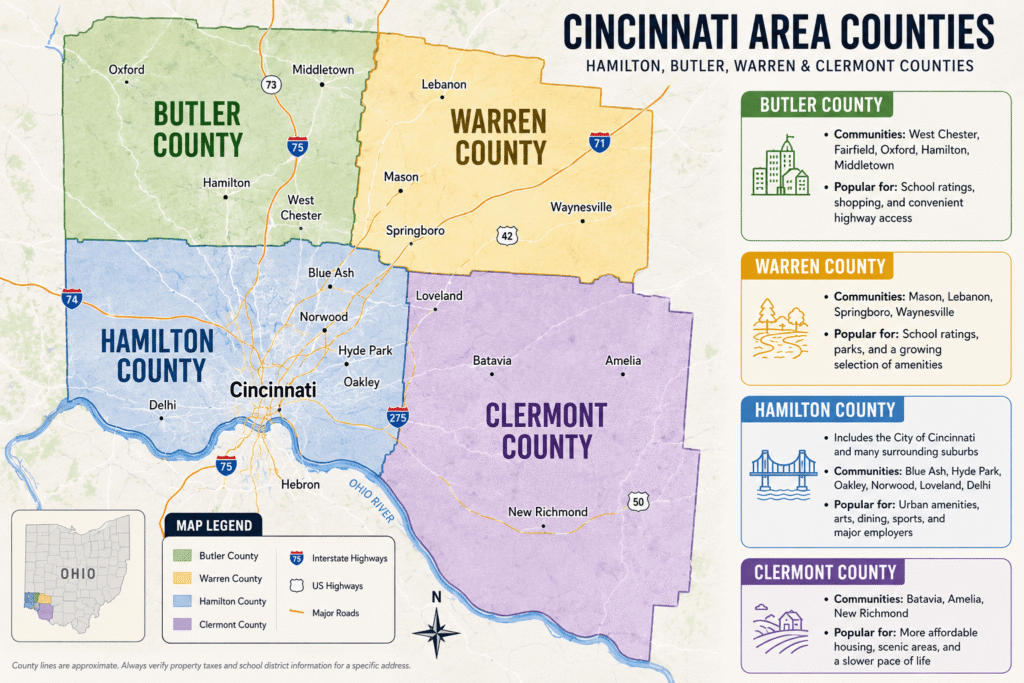
What Is the Property Tax Rate in Cincinnati, Ohio?
These are typical estimated property tax rate ranges homeowners and buyers may see around the Cincinnati area:
The percentage is based on the home's value. For example, a 2% property tax rate means about 2% of the home's value may go toward property taxes each year.
- Hamilton County / Cincinnati: about 2.03% – 2.38%
- Butler County: about 1.18% – 1.23%
- Warren County: about 1.67%
- Clermont County: about 1.30% – 1.55%
- National average: about 1.02%
That means in some parts of Cincinnati, property tax rates can be nearly double the national average.
Always verify taxes for a specific home with the county auditor, your lender, or a local real estate professional before making a final decision.
Is the County Auditor Value the Same as the Home’s Price?
Not always. When a buyer looks up a home on the county auditor’s website, the value shown is used for property tax purposes. It is public information, but it may not be the same as the home’s current list price, purchase price, or market value.
A home’s market value is usually based on what buyers are willing to pay in the current market, recent comparable sales, location, condition, updates, lot size, and demand. The auditor’s value may be higher or lower than what the home would actually sell for today.
In Ohio, the assessed value is generally 35% of the county auditor’s market value. That assessed value is used to help calculate property taxes, but it should not be used by itself to decide what a home is worth.
If you are buying a home, use the county auditor’s site as a tax research tool, not as the final source for pricing the home.
Why Taxes Can Change By Area
Property taxes in the Cincinnati area are not the same everywhere. Rates can vary between Hamilton County, Butler County, Warren County, Clermont County, different school districts, townships, and local levies.
County
Hamilton, Butler, Warren, and Clermont counties can all have different tax rates and local structures.
School District
School district boundaries often play a major role in the total tax amount for a property.
Local Levies
Levies for schools, parks, libraries, public safety, public transit, and other services can affect the final tax bill.
What This Means Day to Day
Here’s what matters most so you don’t feel overwhelmed: property taxes are not just a yearly number. They affect your actual monthly payment.
So when comparing Cincinnati neighborhoods and suburbs, it helps to look beyond the list price. Instead, compare the full monthly cost, including taxes, insurance, and any HOA fees.
What Does 35% Assessed Value Mean?
In Ohio, property taxes are not calculated directly on the full market value of a home. Instead, the county auditor determines a market value for tax purposes, and the assessed value is generally 35% of that amount.
For example, if the county auditor lists a home's market value at $300,000, the assessed value would be about $105,000.
- $300,000 auditor market value
- × 35% Ohio assessment rate
- = $105,000 assessed value
The local tax rate, school district taxes, levies, and any applicable credits or exemptions are then applied to the assessed value. This is why the tax bill can vary by county, school district, and neighborhood.
The 35% assessed value rule generally applies statewide in Ohio for residential property, but the final tax bill can still vary widely based on the local area.
Questions to Ask Before Buying
- What county is the home in?
- What school district is the property assigned to?
- Are there local levies affecting the tax bill?
- Could the tax bill change after purchase?
- How much should I budget for property taxes each year?
Cincinnati Property Taxes FAQs
Are Cincinnati property taxes higher than the national average?
Yes, property taxes in many parts of the Cincinnati area are higher than the national average. Rates can vary significantly depending on the county, school district, and local levies. In some areas, property tax rates may be nearly double the national average, which can have a meaningful impact on your monthly housing costs.
Which Cincinnati-area counties generally have lower property taxes?
Property tax rates vary by location, but buyers often compare Hamilton, Butler, Warren, and Clermont counties when evaluating housing costs. In general, Butler County tends to have lower property tax rates than Hamilton County, while Warren and Clermont counties often fall somewhere in between.
Why do property taxes vary so much around Cincinnati?
Property taxes can vary based on the county, city, township, school district, and local levies. Two homes with similar prices may have very different tax bills depending on where they are located.
Why are Hamilton County property taxes higher than nearby counties?
Hamilton County property taxes are often higher than those in nearby counties because many communities have historically approved additional levies to fund schools, libraries, parks, public safety services, public transit, and cultural institutions.
Do property taxes affect my monthly mortgage payment?
Yes. If property taxes are included in your mortgage escrow account, higher taxes can increase your monthly payment.
How can I find property tax information for a specific home?
Property tax information is typically available through the county auditor's website. Buyers can search by address, owner name, or parcel number to view current tax amounts, assessed values, and property records.

About the Writer
Written by Sarah Rose, Realtor with Plum Tree Realty. Sarah creates Cincinnati relocation guides, neighborhood resources, and home buying content to help buyers better understand what living in Cincinnati Ohio is really like day to day.
Her goal is to make the home buying process easier to understand, especially when comparing neighborhoods, suburbs, housing costs, property taxes, and monthly payments across the Cincinnati area.
Learn More About SarahMoving to Cincinnati? Start Here.
If you are relocating to Cincinnati, property taxes are just one part of choosing the right area. You may also want to compare neighborhoods, suburbs, commute times, housing costs, school district information, and everyday amenities.
I created a Cincinnati Relocation Guide to help you get a clearer starting point before beginning your home search.
Download the Cincinnati Relocation Guide